Fit me
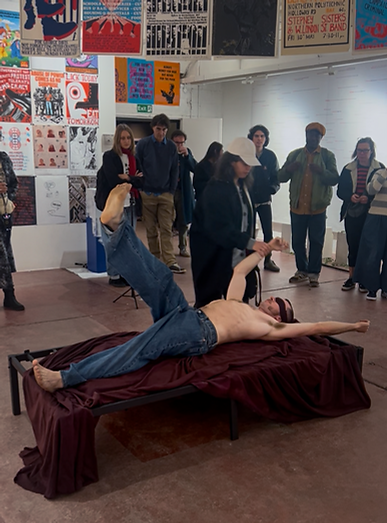
A body lies on a narrow steel bed: too short, too rigid, too exact. People gather around it to witness, to measure, to project. The scene appears simple and almost silent, yet beneath this stillness unfolds a dense negotiation between seeing and being seen, between care and control, between the nervous system and the social frame.
FIT ME revisits the Procrustean myth as an experiment in empathy and neurodivergent perception. There is no choreography. The performance allows the situation itself to sculpt the encounter. Each iteration becomes a mirror of its surroundings, revealing how collective space modulates the possibility of presence. The work functions as altar, experiment, threshold: it poses the question of how far one will go to make another body fit, but also how far one will go to meet it without forcing it.
The performance is rooted in my research on dopamine and the politics of the spike. To remain still is not an act of domination over the body but a practice of surrender. I hold the pose by refusing the dopamine-driven impulse to escape discomfort, and instead lean into connection, breath and touch. It is a form of anti-productivity that depends not on willpower but on trust. The audience’s proximity becomes the force that sustains me. Their hesitation becomes the architecture that holds me in place. The body does not endure through control but through relation.
The work dismantles the heroic grammar of endurance art. It moves away from the fantasy of transcendence through pain and replaces spectacle with fragility, rupture and sensory overwhelm. Endurance becomes microscopic. It exists in the trembling of breath, in the impossibility of being still while being watched, in the suspension between craving and renunciation. It is a neurochemical negotiation materialised at the level of skin.
To watch becomes a form of touching. To breathe becomes a form of exposure. The performer’s body becomes a porous membrane, at once object and oracle, through which others confront their relation to the image, to ethics, to desire. It dissolves the boundaries of theatre and becomes something closer to a contemplative game, a live Glass Bead Game in which each gesture, each delay, each nervous shift becomes a bead in a larger pattern of meaning. No hierarchy, only resonance.
The work proposes that every act of attention is an act of shaping. The audience’s affect becomes the material and their hesitation becomes the choreography. Through this feedback loop of looking and being looked at, FIT ME becomes a diagnostic instrument for the collective psyche, revealing how intimacy collapses into power and how power, under the right conditions, softens into care.
What happens when the neurodivergent mind, hypersensitive and hyperattuned, becomes the stage itself. What new ethics of perception emerge when every breath is an opening and every gaze a wound. FIT ME does not ask to be understood. It asks to be endured differently: as an act of trust, a shared collapse of form, a temporary ecology where vulnerability becomes a way of thinking.